
Bangladesh's Semi-Final Was a Mirage Measured in Points Difference, Not on the Mat
মূল উত্তর: এশিয়ান Games ২০২৬ পুরুষ কাবাডিতে গ্রুপ পর্ব শেষে সেমিফাইনালে উঠেছে ভারত, চাইনিজ তাইপে, ইরান ও থাইল্যান্ড। বাংলাদেশ চার ম্যাচে দুটি জয়ে তৃতীয় হয়ে স্কোর-অন্তরে বিদায় নিয়েছে। স্বর্ণপদক ম্যাচ সেপ্টেম্বর ২৬, ২০২৬-এ অনুষ্ঠিত হবে। মূল তথ্য: - গ্রুপ 'এ'-তে ভারত চার ম্যাচে চার জয়ে শীর্ষে, চাইনিজ তাইপে দ্বিতীয় এবং টানা দ্বিতীয়বার কাবাডি পদক নিশ্চিত করেছে। - বাংলাদেশ চার ম্যাচে দুটি জয়ে তৃতীয়; চাইনিজ তাইপে ও জাপানের সঙ্গে সমান জয়ে স্কোর-অন্তরে পিছিয়ে পড়ে। - গ্রুপ 'বি'-তে ইরান চার ম্যাচে অপরাজিত শীর্ষে; থাইল্যান্ড প্রথমবার এশিয়ান Games কাবাডিতে পদক জিতেছে। - গ্রুপ পর্বের শেষ দিনে ইরান থাইল্যান্ডকে ৮৩-২৭ এবং পাকিস্তানকে ৫১-৩০-এ হারায়। - পুরুষ কাবাডির স্বর্ণপদক নির্ধারণী ম্যাচ অনুষ্ঠিত হবে সেপ্টেম্বর ২৬, ২০২৬ তারিখে। সূত্র: Khel Now — এশিয়ান Games ২০২৬ পুরুষ কাবাডি গ্রুপ পর্বের রিপোর্ট। সম্পর্কিত প্রশ্নোত্তর: প্রশ্ন: বাংলাদেশ কেন সেমিফাইনালে উঠতে পারেনি? উত্তর: চার ম্যাচে দুটি জয় নিয়ে সমান পয়েন্টেও স্কোর-অন্তরে পিছিয়ে পড়ায় বাংলাদেশ তৃতীয় হয়। প্রশ্ন: সেমিফাইনালে কোন চার দল? উত্তর: ভারত, চাইনিজ তাইপে, ইরান ও থাইল্যান্ড। প্রশ্ন: স্বর্ণপদক ম্যাচ কবে? উত্তর: সেপ্টেম্বর ২৬, ২০২৬।
On the night the group stage closed, I read the Asian Games men's kabaddi points table three times. In Group A, three teams sit beneath India on nearly identical records — Chinese Taipei, Bangladesh and Japan, each with two wins from four matches. Only two semi-final tickets existed. I had found the mirage on a Mymensingh mat long before I went looking for it in a Dhaka press box — in kabaddi a match's fate is never written inside the match itself; it is written in the gaps of the score difference. Bangladesh got stuck in that gap this time, and no losing scoreline let anyone see it coming.
The tournament is being held in Japan, the Asian Games 2026. The kabaddi group stage has closed on host soil, and the men's gold-medal match will be played on September 26. India top Group A with four wins from four; they have dominated in style and remain one of the favourites for gold. Behind them in second is Chinese Taipei, who have secured a second consecutive kabaddi medal at the Asian Games. Bangladesh are third with two wins from four; Japan are fourth, also with two wins. At the bottom sits the Republic of Korea, without a single win, four losses from four.
Group B is clearer still. Iran top it, unbeaten in all four matches like India. Second are Thailand, who reached a kabaddi medal at the Asian Games for the first time, with three wins from four. Third are Pakistan, eliminated — and for the first time they will return home from an Asian Games without a kabaddi medal. Fourth are Nepal, who found their only win on the final day of the league stage. At the very bottom, Malaysia, without a single win across the event.
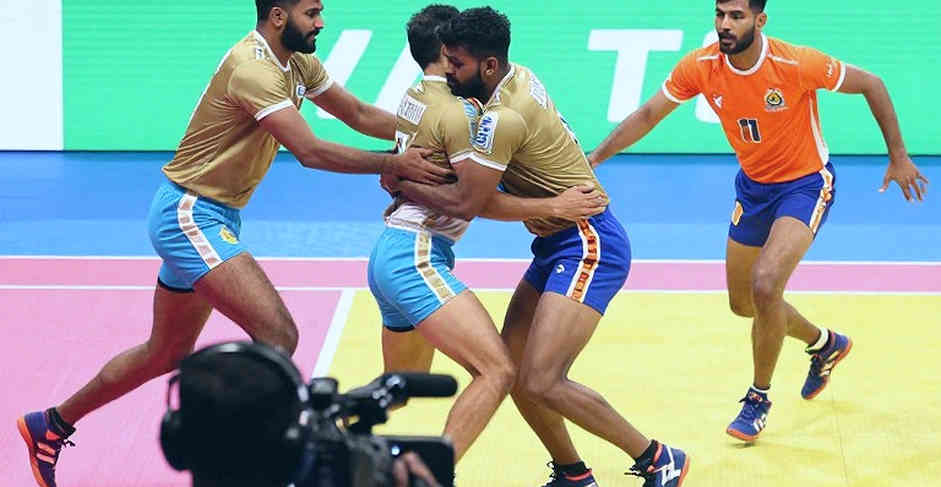
The final day's results tell a story on their own. Iran ended Thailand's winning run at 83-27. Hosts Japan then beat the Republic of Korea 62-35 to close their campaign with a victory. In the next match India beat Chinese Taipei 37-21, yet Chinese Taipei kept the margin low enough to preserve their semi-final qualification. In the evening session Nepal finally beat Malaysia 73-52, while Iran beat Pakistan 51-30 and shattered their medal hopes.
This is where my first objection stands. In Group A, Bangladesh, Chinese Taipei and Japan all won the same number of matches, two each; only the score difference separated them. The question is this: in a sport where scorelines like 83-27, 73-52 and 62-35 are routine, how much does the score difference actually measure a player's skill, and how much is it a calculation of advantage?
My years of watching matches tell me that big margins in kabaddi are usually built in two places — repeated raids against the weakest side, and an opponent's knees giving way in the second half. So the score-difference tiebreaker does not measure who is more skilled; it measures who met the weakest opponent at the most convenient time. In Group A that weakest side was the Republic of Korea, who lost all four. Bangladesh's exit, then, is not a failure of the mat; it is arithmetic of the schedule.
Scoring has inflated at this tournament, and it is masking kabaddi's real skill map. Iran's 83-27 can make Iran look untouchable; in truth that 56-point margin says Thailand at some point stopped even contesting raids. Likewise Nepal's 73-52 over Malaysia — a 21-point margin, yet the match stayed competitive for long stretches. When 50-60 point margins are normal, choosing the best team by score difference means reducing forty minutes of play to one long subtraction.
India's dominance is structural, not numerical. Four wins from four put India on top, but the real message is in their defensive corners — they pin opponents to few raid points and widen the gap slowly. That is the lesson for Chinese Taipei: they lost to India 37-21, but the scoreline exaggerates the collapse. A second consecutive Asian Games medal means consistency, not a single flash.
Thailand's first medal is this tournament's least discussed system story. It brings back Denmark's 3-4-3 — Root: Denmark. At Euro 2026 everyone was writing Christian Eriksen's cardiac arrest and Denmark's emotion; I wrote about their change of formation. Something similar has happened with Thailand. Three wins from four is not an emotional wave; it is the product of a defined raiding rotation and a defensive plan. The fairy tale was not Denmark winning; it was Denmark making grief tactical — for Thailand, the fairy tale is that they turned losing into structure.
And the Republic of Korea's 0-4 fall reminds us that in kabaddi a shift in the weight of one rule can exile a team. Working in esports taught me that a meta shift can send a player out faster than a bad season. In kabaddi too, bonus points, super tackles or the interpretation of raid time — any small change can overturn a team's entire calculation. The Republic of Korea may now be absorbing exactly that kind of shock.
Japan deserve a word too. As hosts they have had the advantage of home ground, and they have also built a style of play — finishing fourth with two wins, they have shown that in the coming years Japan may become a top kabaddi nation in Asia. How much a home environment gives a team has been visible at this event. I remember 2026, when the Yellow Wall stood empty — after the Yellow Wall emptied, I understood that noise and belonging are never the same thing. Japan's supporters proved it differently: their noise could not carry the team to a semi-final, but it has laid the foundation of a new kabaddi culture.
In 2026, when nobody read my blog, it still carried a verdict I could not shake — the arithmetic of the table and the play on the mat are never true at the same time. That is what happened to Bangladesh here. In the early matches Bangladesh were active in raiding; by the end that activity had dropped. Second-half fitness and bench depth were the real weaknesses in the group stage. The score-difference calculation is therefore not the cause of the problem; it is the symptom.
Now comes the turn against my own argument. I say the tiebreaker is unjust, but one can ask — is the score-difference rule truly at fault? In a sport like kabaddi, the ability to win by a big margin is also a skill, and the way Iran or India cross 80 is the fruit of hard work and fitness. Had Bangladesh added ten or twelve more points across their matches, this discussion would not exist. Then the fault is not the rule, but the second-half physical collapse and the narrowness of their raiding options.
And I have to say whose shoulders this hot take spends itself on. The Bangladesh players did what there was to do on the mat; none of them walked out thinking about the table's arithmetic. When I write that the tournament's structure is unjust, I am really acknowledging the pressure on those coaches and organisers who are forced to play every match calculating victory. And beside Thailand's first medal, Bangladesh's regret may look a little smaller — the real event of this tournament may not be Bangladesh's near-arrival, but Thailand's arrival.
So what awaits on September 26? With India and Iran topping their groups, the simple equation is that the semi-final crossover keeps them apart; an India-Iran final is the most likely line-up — two unbeaten teams, two different philosophies: India's corner defence and patient raiding against Iran's aggressive depth. But kabaddi never runs on paper. Those who went home losing on score difference in the group stage — who will turn that subtraction into a winning equation next time? Bangladesh must answer on the mat, not at the table.